Research
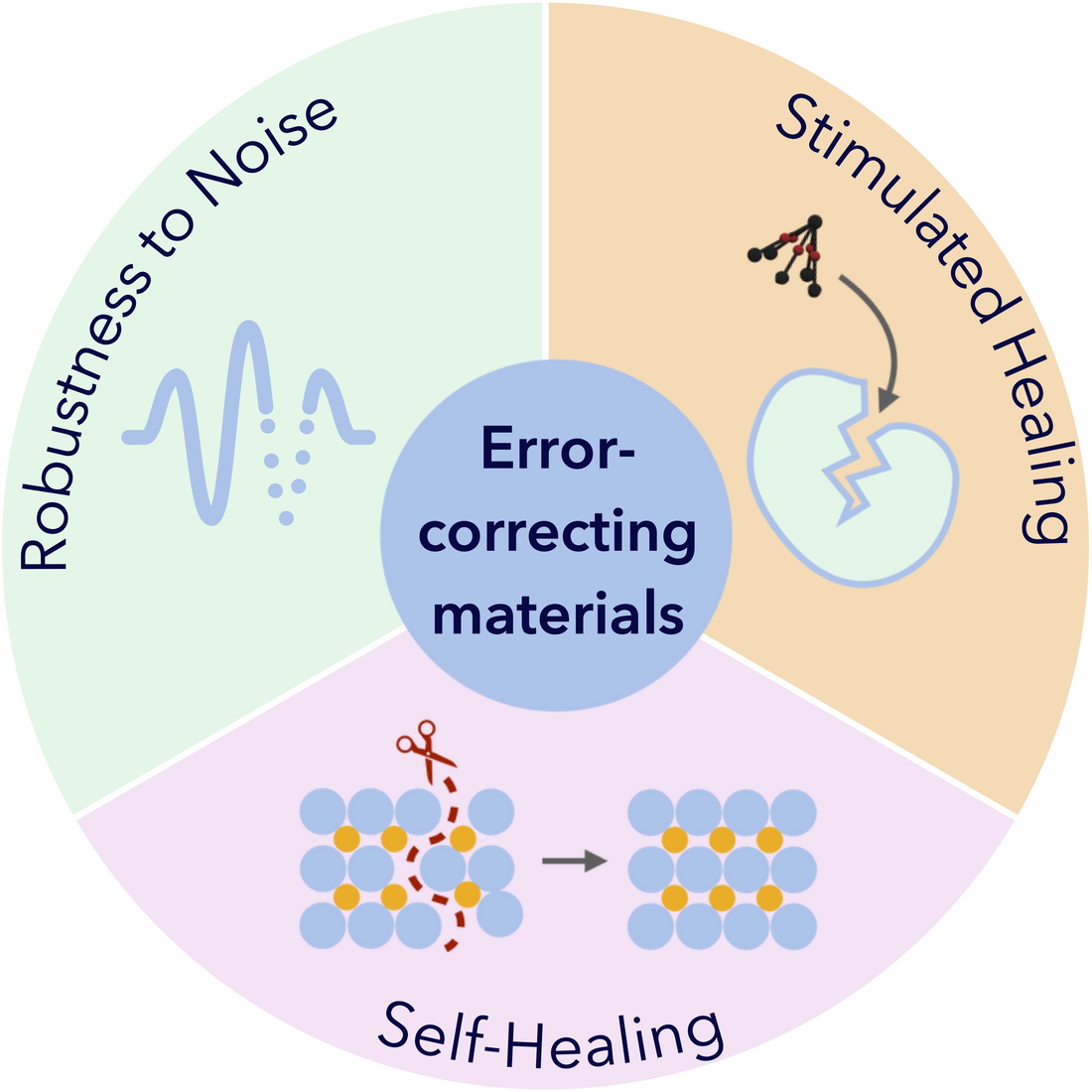
The King group works to understand and design materials that are dynamic, responsive, and can correct their own errors. Unlike human-made materials, biological systems are strikingly robust to errors in the face of dynamic, out-of-equilibrium environments. Living matter corrects errors across six orders of magnitude: nanometer-scale kinetic proofreading achieves exponentially lower error rates in DNA replication than can be reached at equilibrium, and millimeter-scale vasculature rapidly remodels in response to changes in blood flow. Because many biological systems are capable of robust error correction, it should be possible to design synthetic materials with similar functions.
Error-correcting materials would revolutionize modern technologies, ranging from artificial joints that could be revitalized with error-correcting synthetic enzymes to last a lifetime instead of just a decade, to phone screens that repair themselves while recharging overnight. Creating these materials will require both fundamental discoveries in the physical and biological laws that govern these complex, dynamic interactions and innovations in computational and inverse design methods. So how do we design error-correcting materials without the luxury of billions of years of evolution?
Recent publications
Inferring interaction potentials from stochastic particle trajectories
Physical Review Research 7, 023075
2025Scattered waves fuel emergent activity
Physical Review Research 7, 013055
2024Tuning colloidal reactions
Physical Review Letters 133, 228201
2024Programmable patchy particles for materials design
Proceedings of the National Academy of Sciences 121, e2311891121
See the full publication list →